Workflows
Flags and the athlete's usual
A flag puts one check-in answer in front of you in Review, the list of athletes and conversations that need you. Each answer also shows beside the athlete's usual, their own average for that question over the last 28 days. You compare an athlete with themselves, so a 6 from an athlete who always answers 8 stands out.
What it is
A flag marks one answer on a form. A form with a flagged answer opens a thread in Review. A form with nothing flagged opens no thread, and its answers show as a quiet line on the athlete's row.
An answer can be flagged for four reasons:
- Pain or illness — a Yes to a question that means pain or illness.
- The question's flag rule — the answer matches the line you set on the question.
- Below usual — the answer is clearly worse than the athlete's usual.
- The athlete asked for a look — the athlete tapped "I'd like my coach to look at this".
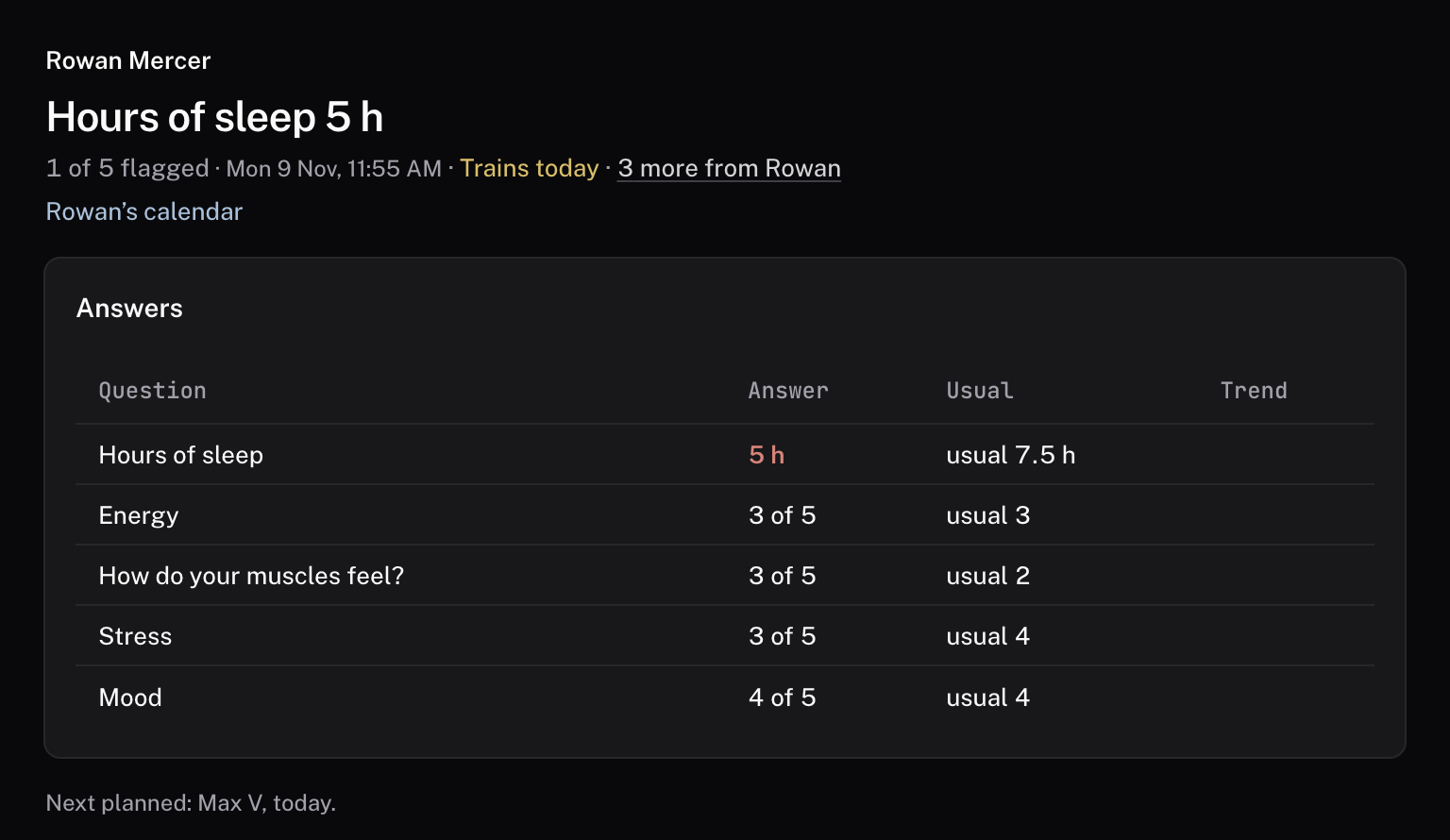
Review's Reasons list files each thread under one reason, such as Pain, Athlete asked, or Flagged form. A flag rule and below usual both read Flagged form. In the thread, the flagged answer shows in red.
Pain or illness and an athlete's request open an urgent thread. The other reasons open a thread under Needs a look. Your athletes never see why an answer was flagged.
Where to find it
You set flags on questions in BUILD > Forms. COACHING > Automation > Alerts lists every question with a flag rule, and the alerts that are built in.
The parts
Flag when
Flag when is a switch on a question in the form editor. Turn it on and set the line:
- A number or a scale — at or below, at or above, or exactly a value, such as a sleep score at or below 2.
- Yes / no — flag on Yes or on No.
- Pick one — flag on one choice.
A flagged answer goes to Review and can drive rules. See Build a check-in.
Pain and illness
Set a question's Means to Pain or Illness. A Yes to that question is always flagged, with no flag rule needed.
The athlete's usual
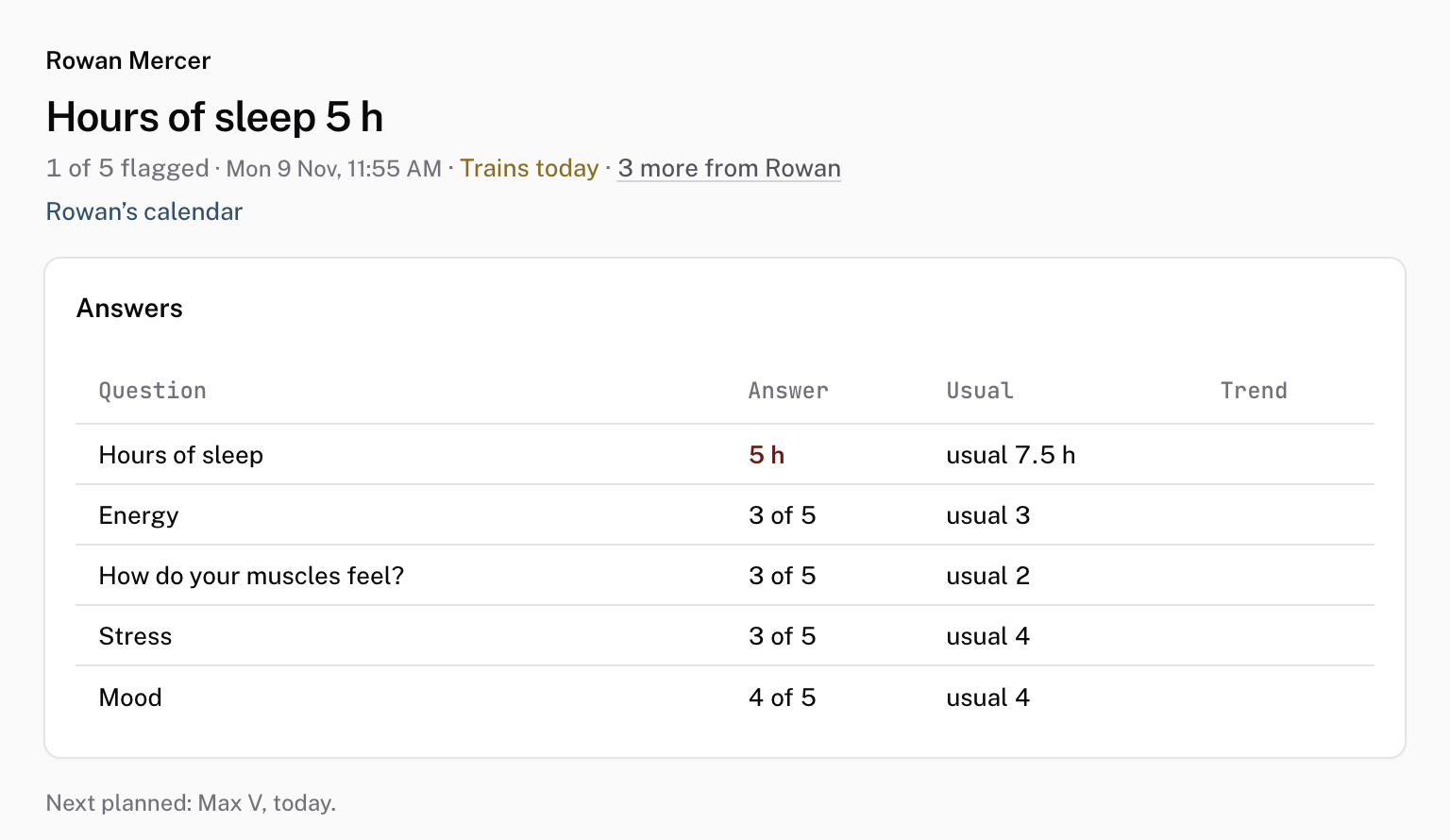
The usual is the athlete's average answer to that question over the 28 days before this answer. It counts only number and scale answers. Review shows it beside the answer, such as "usual 7.5 h". The athlete page's Forms grid shows it for each check-in question.
A new version of a form keeps the usual going, because the usual follows the question across versions.
Below usual
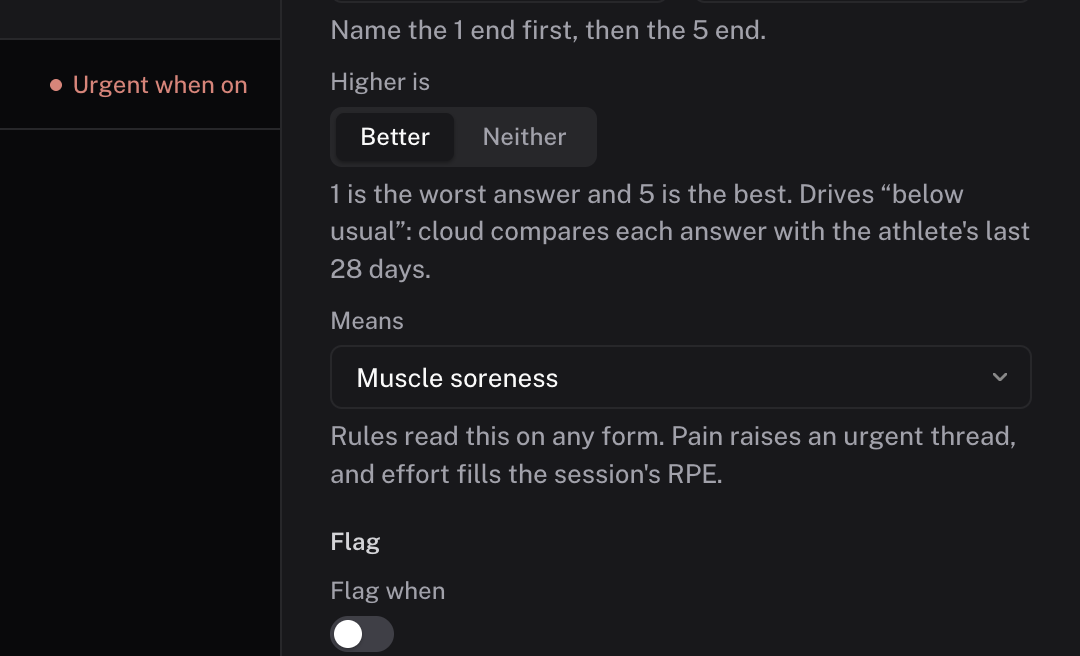
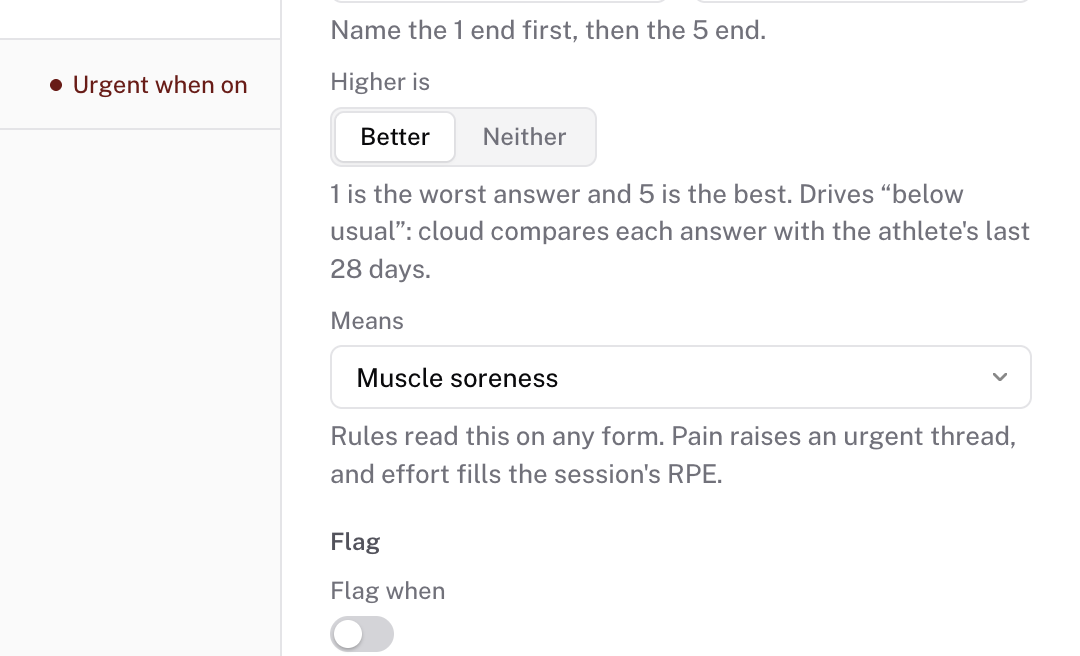
Higher is on a scale or number question says whether a higher answer is Better or Worse. Neither turns off every comparison with the usual for that question. On a scale with Higher is set, an answer is flagged as below usual when all of these are true:
- The athlete answered the question at least 5 times in the last 28 days.
- The answer is at least 1 point worse than the usual on a 1–5 scale, or at least 2 points worse on a 0–10 scale.
"Worse" means lower when Higher is is Better, and higher when it is Worse.
 Higher is
The usual in a rule
A rule can read the usual too. Its condition is below usual compares the answer with "their average over the last 28 days". It needs at least 3 earlier answers, and any amount worse than the usual counts. The condition is offered only on a question with Higher is set to Better or Worse.
The condition is flagged is true when the question's own flag rule holds, or when the athlete answers Yes to a pain or illness question. See set up a check-in rule.
The athlete's request
Turn on Athletes can ask you to look at an answer in the form's settings panel. The form then ends with "I'd like my coach to look at this", and a tap makes the thread urgent in Review.
Limits
- The below-usual flag reads scale questions only. A number question shows a usual, but only a rule's is below usual condition compares a number with it.
- A 1–5 scale runs from worst to best, so its Higher is offers Better and Neither.
- Answers with words, choices, or yes and no have no usual.
Common questions
Why wasn't a low answer flagged as below usual?
The athlete needs at least 5 answers to that question in the last 28 days, and the drop must be at least 1 point on a 1–5 scale or 2 points on a 0–10 scale. Check that the question's Higher is is set.
Does a rule need a flag to run?
No. A rule reads the answers directly. A flag and a rule can come from the same answer, and the flag opens the thread whether or not a rule changes the session.
Related
Stuck? Message us directly.